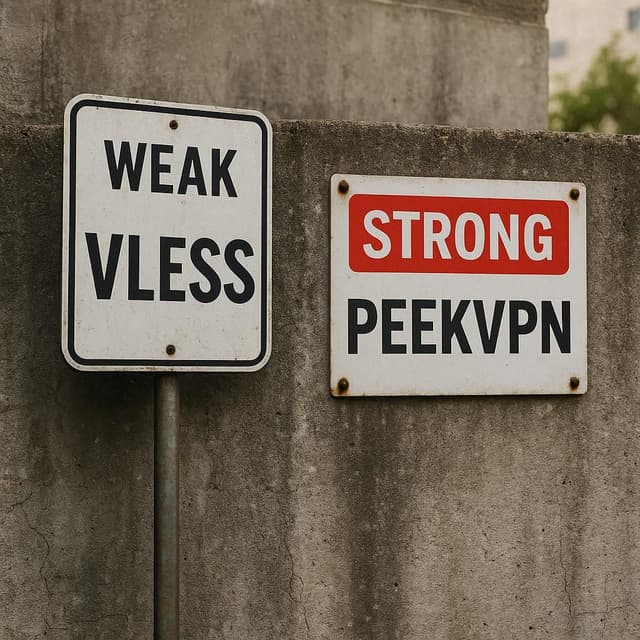
In recent years, VLESS has gained popularity as a lightweight protocol within the V2Ray / Xray ecosystem. It is often presented as a modern alternative to traditional VPNs, especially for bypassing internet restrictions. However, this perception can be misleading. VLESS, in its “classic” form, is not inherently secure and, in many cases, is poorly suited for reliable censorship circumvention.
The core issue lies in the protocol’s design. VLESS does not include built-in encryption. Instead, it relies entirely on external transport layers such as TLS to secure traffic. While this makes the protocol more flexible and efficient, it also means that any weakness or misconfiguration in the transport layer directly compromises the entire connection. In other words, VLESS itself provides no safety net.
In many real-world deployments, VLESS is used in relatively simple configurations, such as VLESS over TCP or VLESS over TLS without advanced obfuscation. In these setups, a significant amount of metadata remains visible to network observers. This includes the server’s IP address, the SNI (Server Name Indication), TLS fingerprints, and traffic patterns such as packet sizes and timing behavior. Even though the payload may be encrypted, this metadata is often enough for modern DPI systems to identify and flag the connection as proxy traffic.
One of the most critical weaknesses of standard TLS-based setups is the exposure of SNI. Since SNI is transmitted in plaintext in traditional TLS handshakes, it allows network operators to see which domain a user is attempting to connect to. This enables precise blocking, filtering, and traffic classification, even when the actual content remains encrypted. As a result, connections using VLESS with standard TLS can be easily targeted and disrupted.
Another common issue is the use of self-signed certificates. While technically functional, self-signed certificates deviate from normal HTTPS behavior and are significantly easier to detect. They also introduce additional risks, such as increased susceptibility to man-in-the-middle attacks if certificate validation is improperly handled. From a censorship-resistance perspective, such configurations stand out rather than blend in.
Because VLESS depends entirely on TLS for security, any compromise of the TLS layer directly impacts the confidentiality of the connection. If a private key is leaked or the TLS setup is flawed, attackers may be able to intercept or manipulate traffic. While modern TLS versions offer protections like forward secrecy, they do not eliminate all risks, especially for active connections.
Another important consideration is the lack of a standardized, “safe by default” configuration. VLESS is essentially a toolkit rather than a complete solution. It supports multiple transports, configuration styles, and deployment patterns. This flexibility is powerful, but it also means that security depends heavily on the user’s expertise. In practice, many deployments are suboptimal or insecure simply because they are misconfigured.
In restrictive network environments, these weaknesses become even more apparent. Basic VLESS configurations often fail to withstand advanced DPI systems. Servers get blocked, connections become unstable, and performance degrades over time. Without sophisticated obfuscation techniques such as CDN fronting or advanced transport layers, maintaining reliable access becomes a constant challenge.
Taken together, these factors highlight a fundamental point: VLESS is not a secure solution by default. It can be part of a secure system in the hands of an expert, but it is not designed to provide consistent, out-of-the-box protection against modern censorship and traffic analysis techniques.
In contrast, solutions like PeekVPN take a fundamentally different approach. Instead of acting as a configurable framework, PeekVPN is designed as a complete, security-focused system. One of its key characteristics is the use of TLS 1.3 to protect 100% of user traffic. This ensures that all data is encrypted using modern cryptographic standards, without exceptions or fallback modes.
Another advantage is the elimination of unsafe configurations. Users are not required to manage certificates, choose transport protocols, or fine-tune encryption parameters. This removes a major source of risk and ensures that all connections adhere to a consistent security baseline.
PeekVPN also focuses on minimizing metadata exposure. By reducing observable signals such as identifiable fingerprints and unnecessary protocol leakage, it makes traffic appear closer to standard HTTPS. This significantly improves resistance to detection and blocking by DPI systems.
Additionally, the system is designed with traffic analysis in mind. Factors such as timing behavior, packet structure, and session patterns are handled in a way that reduces the likelihood of detection, even under more advanced inspection techniques.
Ultimately, the difference comes down to consistency and reliability. While VLESS offers flexibility, it also introduces variability and risk. PeekVPN, on the other hand, provides a uniform level of protection across all users and scenarios.
For anyone seeking stable, private, and censorship-resistant internet access, relying on a fully integrated solution with enforced TLS 1.3 encryption is a far more practical and dependable choice than attempting to assemble a secure configuration from individual components.